Tuesday, December 29, 2009

Good Ads? Bad Ads?

In week 7, we were taught the characteristics of a good ad and how an ad can appeal to its target audience.

Target Audience
Rule of thumb, as always, know your audience.
  1. Tolerate - Know what your audience can/cannot tolerate. E.g. children (TA) are intolerable of gory pictures.
  2. Distasteful - Tastefulness is subjective. It varies from culture to culture.
  3. Limits - Advertising ethics are taken into consideration.
  4. Cool factor - Does it appear to be "cool" to your TA?
  5. Humour, culture and frame of reference - Frame of reference is the association with something, e.g. the use of blue colour is associated to masculinity. Humour and frame of reference differs from culture to culture.
Bottomline, respect your audience. Don't underestimate them but do understand them. They are what your company represents.


"I AM AN AD!"
While walking down the street, sometimes you see ads that scream "I AM AN AD!". More often than not, this type of ad doesn't work. It may work sometimes, e.g. for ads with the product as the main visual.


  • The product is the main visual.
  • The company logo.
  • A formulaic layout that is used by millions of others.
  • The copy sounds like a sales pitch.

A Typical Ad Layout
The layout of a typical ad usually looks like a visual sales pitch, e.g.


The product is obvious and the ad is not visually unified. So what is meantby unified visuals? Meaning, the image and the typography don't work together to bring the same message. As we all know, it is important a consistent message is sent to target audience for maximum effects.

Also, the ad has little visual impact and it is not memerable. There is no visual surprise and it is boring.

An Atypical Ad Layout That Just Works Better
On the other hand, some ads just work better. Why? I'll explain.

The ad is visually surprising and engaging. It stops an audience on his way (remember "Huh?" in SHRED?). It makes the audience remember the ad message.

The ad is seductive as it creates emotions and feelings within you, e.g. a likeable feeling. The idea is fresh such that it is motivating to read. People would pause to absorb the message. Most of all, it is worthy of being hung on the wall.


8 Design Pointers
Of course, design an atypical ad is not easy. However, there're some design pointers we can always follow.

  1. Be daring when creating contrast. E.g. big visual, small type (or vice versa).
  2. The line breaks of type follow speech pattern.
  3. Line breaks slow down communication which is why- refer to point no. 2.
  4. Resist the usual - because good ads are fresh, visually surprising and engaging.
  5. Create a visual hierarchy. Consider which element is more important.
  6. Avoid visual clutter.
  7. Create visual interest. It helps when the image is interesting.
  8. The ad entertains visually.


As usual, we were given a design task! This week, we were given a corporate and we were supposed to redesign it.

First off, we analyzed and identified the target audience. There are also things that were taken into account:
  • Background of the clients (organizations).
  • Culture of the organizations.
  • What they do.
  • What they are famous for.
In the end, we targeted the key decision-makers of the clients (TA) who are the people in the marketing department.

For the ad to appeal to the TA, the TA have to feel good about the ad and make known to them what they can use.

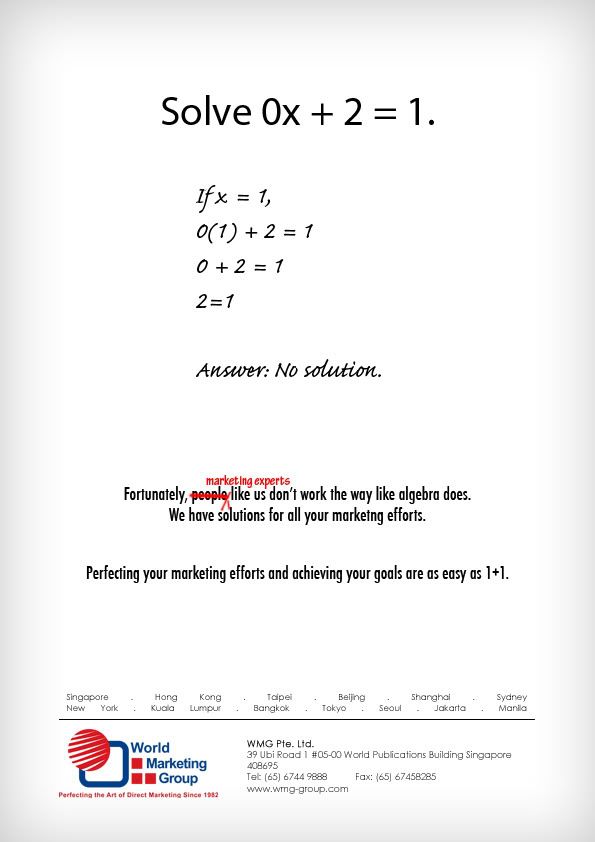
And there we go, I've come up with this!

Sunday, November 22, 2009

On Strategy and On Target

A strong brand creates a strong bond with its consumers, relates to them and resonate with them. Successful brands are those that make an emotional connection to its consumers.

So how do a company positions its products/services? How does it establish its brand? No doubt, advertising is one of the widely used tools in this new media age.

Like drafting a public relations plan, there are a few elements to take note of when developing a good advertising campaign: goal, strategy, target audience and media vehicle. More specifically, a good ad should be on strategy and on target.

Advertisers must clearly focus on the main objective, accurately explain the benefits and specifically highlight why consumers should buy that product. A good key message for a product delivers a real benefit to the consumer. The information must be delivered in a way that is intrusive and interruptive and at the same time, be based in truth. It must sound natural and believable, so the targeted audience internally nods its approval.

They need to speak to consumers in a way that makes the audience believe they are understood and valued. A good ad demonstrates an understanding of the target audience's needs and wants. Part of the success of an effective advertising campaign is due to the ad's ability to change how consumers thought.

Of course, there are many factors that should be taken into consideration. Target audience may segmented based on their geographic, demographic, psychographic or behaviour. Therefore, when advertising in an international market, cultural differences are taken note of.

Today, ads are no longer limited to traditional media. The Internet age is taking over the world. Advertisers are now using tools like blogs, social networking sites, podcasts to target its specific niche.


Summary - The Power of the Brand

  1. A brand is something the audience claims as its own.
  2. There is a relationship between a brand and the consumer.
  3. Agencies succeed because they know what will resonate with the target audience.

The Five-Step Creative Process
  1. The assignment - The agency identifies the client's identity and overall message. A creative brief is then developed to guide the strategic planning.
  2. The preparation - The agency compiles a creative brief by conducting research, gathering ideas and identifying the audience. The creative solution matches the strategy that was developed by the agency.
  3. The creative process - The agency's creative teams become informed about the objectives and audience.

  4. The solution - The creative teams develop several campaign solutions. They select the best one to present to the client.
  5. The verification (evaluation) - Creative solutions must always be evaluated to determine if they
    • solved the correct problem;
    • targeted the correct audience;
    • remained on strategy;
    • used the appropriate tone of voice;
    • delivered a relevant and believable message with a needs-driven benefit.

  6. Agencies' focus is to develop a message that can work equally well in all media in order to reach their target audience.

Work at Your Own Pace
  1. Some ideas take longer and must be allowed the proper time to percolate. It is better to have an on-strategy than to have a weak campaign that isn't well thought out.

On Target and On Strategy
  1. Advertising must clearly focus on the main objective, accurately explain the benefits and specifically highlight why consumers should buy that product.
  2. It must also be on target.
  3. The information must be delivered in a way that is intrusive and interruptive.
  4. The message must sound natural and believable, so the targeted audience internally nods its approval.
  5. It must also make an emotional connection with the audience.
  6. Advertisers need to speak to consumers in a way that makes the audience believe they are understood and valued.
  7. Visuals and messages are becoming more straightforward, more relevant, and more realistic.
  8. "For an idea to get noticed, it has to be disruptive. But the disruption has to be based in truth."

On Strategy and On Target: Speaking Clearly to the Audience
There are a few ways an ad gets its audience's approval
  1. Part of the success of an effective advertising campaign was due to the ad's ability to change how consumers thought.
  2. The advertising was able to make consumers rethink their beliefs.
  3. Applied intuition, radical common sense and solid judgement will result in truthful, beautiful and relevant ideas every time.

Targeting Specific Audience
  1. Sometimes the product needs to be repackaged to become more useful to the user.
  2. Reaching a specific audience goes beyond just the advertising message and must also embrace the packaging and amentities.
  3. When targeting a segmented target in an international market, cultural difference is taken into consideration.
  4. A good key message for a product delivers a real benefit to the consumer.
  5. On-strategy ad demonstrates an understanding of needs and wants.
  6. Besides on target, the right media should be used.

Other Ways to Communicate with the Target Audience
  1. Today, advertising campaigns are no longer limited to ads, billboards, direct mail and TV commercials.
  2. New media have emerged, e.g. podcasts, blogs, web banners, RSS, etc.

It's Not Just about the Media
  1. Everything needs to work together to support the strategy: the media, the message, the visual, the tone of voice, the shell and all other aspects of the ad.
  2. Some good ads may have been straightforward, but they delievered an intelligible and relevant message that persuaded the target audience to buy the product.
  3. The goal of an ad is to:
  • create excitement by using a medium in an unexpected way;
  • emphasize the company of brand.

Thursday, November 5, 2009

"SHRED"

Today, I've learnt the 5 elements in an effective ad - SHRED.

Deconstruct the ad
- The first step is to analyse the message that the advertiser wants to convey. The messages should be easily identified and deconstructed. E.g. in the parody ad for The United Colours of Benetton, the message can be deconstructed into:
  • the arrogant look
  • the money
  • the formal shirt
  • the slogan.


These are in contrast with the campaign that the United Colours of Benetton had came up with.

Emotion and Response
- The ad should be able to provoke emotion. Emotion is closely linked to response. Emotion portrayed with elicit the response the advertiser wants (call-to action).

Huh?
- The ad should grab attention. The audience would go: "Huh?"

Science
- However original the advertiser wants to be, some methods are proven in terms of design. These methods are proven to work. You don't always have to go against the norms.

Friday, October 23, 2009

Welcome aboard!

Hello people!

This is a blog I've just created for the module, Design and Illustration.

The reason why I chose this elective was I was into arts even though I'm only a beginner in this. I can't paint for nuts but I used to sketch a lot.

Being able to doodle or sketch, I have to say, is a gift. It just expresses better than words. There were a few phases in my doodlehood. In primacy, I liked to draw people, girls in particular, especially characters from Wuxia novels.

Few years ago the anime craze came in. I don't watch anime but I do surf Deviantart once in a while. There were artists who could draw really well and they posted their work on the website.Their styles ranged from manga to chibi. Chibi somewhat caught my eyes. Chibi is a style where the characters are big-headed with disproportionate body.

I find it simple to draw, and I liked the facial expressions used commonly in Japanese comics.


Back then I had a bunch of friends who are really crazy and we would do stupid things together. I find ourselves eccentric and that also inspired me to draw more of them!


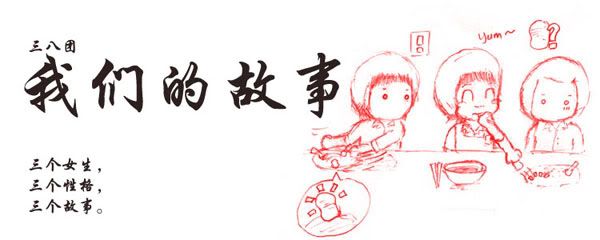
Our hair were distinctively unique in their own way, so it was easy to identify the characters. From left, it's me, my friend KK and MK. That was us in the canteen. KK would steal MK's food and I quickly took my plate away. Ah~ I miss those days~

And of course, how can there be exciting school life without a crush?


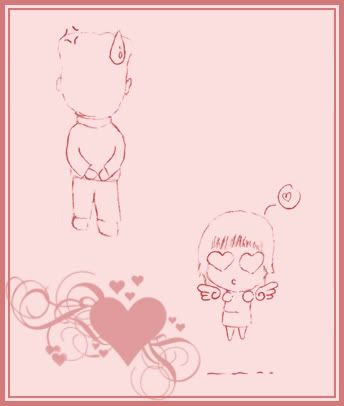
He always walked past the corridor and all I could see was his back. -_- And I was head over heels about him.

There are still more sketches but I can't find them anywhere. Oh well.